THE XIITH INTERNATIONAL RANGELAND CONGRESS, ADELAIDE, JUNE 2025
December 18, 2025
Compiled by members of the Australian Organising Committee
Rangelands cover about 80 per cent of Australia’s land mass, and are important contributors to the nation’s wealth, culture, natural resources and identity. It was fitting that the XIIth International Rangeland Congress was held in Adelaide, South Australia in June 2025, being the third IRC held in Australia, with preceding Congresses held in the USA (twice), France, India, South Africa, China, Argentina, Canada and Kenya.
Planning for the XIIth International Rangeland Congress
After our bid to hold the XIIth IRC in Adelaide was accepted in 2020, it was time to panic get busy. Key chores along five year journey were:
- Recruiting an Australian Organising Committee (AOC) and assigning portfolios to the members. Most of those ‘conscripted’ are members of the ARS. As well as providing people, we were grateful for the support from the Society, both in sponsoring the bid, and in providing a loan of $20,000 to fund early planning. The members of the AOC are shown at the end of the article.
- Establishing a company to provide a legal basis for the Congress, and to avoid financial risk.
- Appointing a Professional Conference Organiser – being All Occasions Group in Adelaide.
- Developing a theme for the Congress and sub-themes and inviting keynote and submitted presentations, followed by the review of the submitted abstracts and papers.
- Arranging workshops, social functions, mid-congress tours and pre-congress tours.
- Seeking sponsorship from local, national and international agencies and corporates.
- Providing financial support for registration, travel and accommodation on a merit and needs basis to delegates who would otherwise not have been able to attend the Congress.
- And – umpteen logistical, organisational, registration, program and publication-related chores which occupied much time, and occasionally tested our patience and endurance, but we got there.
Theme and sub-themes for the IRC
The theme for the Congress was Working together for our Global Rangelands Future and the diversity in those attending and in the material presented, and the ‘buzz’ during the Congress definitely showed that the rangelands community is well committed to ‘working together’.
There were seven sub-themes for the Congress: (1) Valuing rangelands and pastoral systems for their societal contribution; (2) Co-design, partnerships, and incorporating traditional knowledge for more enduring rangeland outcomes; (3) Technology, information systems, communication, and big data to aid monitoring and decision making; (4) Integrating rangeland ecology into management; (5) Managing risk – climate and other system shocks and trends; (6) Livestock production systems in a world of changing drivers; and (7) Multi-functional land use in rangelands – moving beyond niche opportunities.
How well did the Congress deliver?
Who came?
We welcomed 772 delegates from 46 countries to Adelaide, who generated a robust international flavour in the presentations, discussions, tours and resolutions passed by the delegates. We had budgeted on 600 delegates and having the extra people enhanced the quality of the discussions, the constant networking in the Adelaide Convention Centre and improved the finances. It is apparent that the IRC will deliver a significant profit to the International Rangeland Congress Continuing Committee which can be used in support future Congresses in a variety of ways.
Who supported the Congress?
We received $736,000 in sponsorship, as compared to an original budget of $420,000, thanks to the great efforts led by Andrew Ash. The sponsorship was roughly half and half national and international. We were fortunate in that the sponsorship from USA agencies was received before the current administration stopped support for events such as the IRC.
The greater than expected international sponsorship allowed us to offer assistance to attend to 90 people, with the process of assessing applicants capably led by David Phelps and Nicole Spiegel.
What was presented?
The keynote presentations and submitted papers were extremely well organised by Alex Baumber and Cecile Godde and their team into 45 separate sessions over 4 days. This was not easy with changes being made until nearly the last minute before the Congress. The proceedings were professionally overseen by Sarah Macdonald and her team of hard-working reviewers and contained 494 papers with 292 presented as keynote, full and lightning presentations. A further 192 posters were available for delegates to view. The fantastic work led by Sarah and the editorial team meant that the proceedings were compiled by the start of the Congress and are available on-line.
The keynote presentations, the volunteered papers and posters reflected the increasing inter-connectedness between what is happening in the rangelands and what is happening in the rest of the world’s economies, social systems and governance. They also recognised the need to integrate trends in technology, artificial intelligence and communication into the day-to-day lives of rangeland decision makers and residents. Finally, the traditional Indigenous knowledge of long-established rangeland cultures, which for too long has been under-valued, is receiving its rightful attention and recognition.
A couple of key observations – the role and importance of women in rangeland research and management is growing steadily and there were outstanding key note presentations from women taking leading roles in several countries, and in the Women’s Panel. Further, the diversity amongst those present reflected favourably on how ‘rangelands’ as a subject area is drawing in people from many disciplines and walks of life. Let’s look forward to more of these developments in the future.
And the workshops?
As well as the formal sessions of the Congress, pre-Congress workshops dealing with traditional Indigenous knowledge, global rangeland standards in certification and monitoring, and the role of pastoral multifunctionality in contributing to growing societal challenges attracted many participants. Over 200 delegates enjoyed celebrating 50 years of the Australian Rangeland Society. Dana Kelly did a great job in organising a Traditional Knowledge Workshop and a well-received Women’s Panel during the IRC itself
What about the tours?
Organised by John Gavin and his team, we had more tours than normal at IRCs. Over 60 delegates participated in pre-Congress Tours arriving in Adelaide from Perth, Alice Springs, Longreach and Sydney. And as far as we know, none of the buses broke down – something of a first!
Six mid-Congress tours learned about Indigenous culture, water management in the Murray-Darling Basin, research and development in dryland farming, the rangelands to the east of Adelaide, the scenic attractions in the Adelaide Hills, and the world famous wineries in the areas close to Adelaide.
The views of the delegates – a lightning summary!
The post-congress evaluation survey was completed by 193 (25 per cent) of the delegates. The organisation of the Congress was assessed as being excellent or very good (80 to 90%), and the content and quality of speakers were rated by 80 per cent of the respondents as being excellent or very good. Over 90 per cent of the respondents agreed that the IRC provided excellent or very good opportunities for ‘knowledge building, connecting with colleagues and creating opportunities for future collaborations’. The social events were all enjoyed, although the feedback was that we could have done better with the Conference Dinner. Next time ….
And … who did it?
The following members of the Organising Committee are acknowledged and thanked for their hard work; all provided on a voluntary basis in a cheerful and collaborative manner.
Pieter Conradie, Nicole Spiegel, Andrew Ash, Cathleen Waters and Don Burnside chaired the Australian Organising Committee at various times between 2021 and 2025. Committee members and their portfolio areas were: Andrew Ash and Saravan Peacock (Sponsorship Sub-committee), Alex Baumber and Cecile Godde (Program Sub-committee), Donald Burnside (Treasurer and Director XIIth IRC Limited), John Gavin (Tours Sub-committee) Sarah Macdonald (Publications Sub-committee), Dana Kelly and Stephen van Leeuwen (Indigenous liaison), David Phelps and Nicole Spiegel (International liaison and delegate support), and Alison Nicolson (social media). Special mention needs to be made of the unwavering commitment and time that Don Burnside devoted to the Congress. This included being Congress Co-Chair, managing the ever-challenging budget and the Congress company, as well as leading the pre-Congress tour from Perth to Adelaide and one of the mid-Congress tours.
Thanks also for the excellent support and advice provided by Anne-Marie Quinn and her team at All Occasions Group, especially Patti Sbrissa, Sophie Stefanoff and Chelsea O’Brien.
Finally, we hope that the discussions and presentations at the XIIth IRC in Adelaide have contributed to progressing the science and art of rangeland management across the many domains in the world. We look forward to continuing this important work at the XIIIth International Rangeland Congress in Ulan Baator, Mongolia in August 2029.
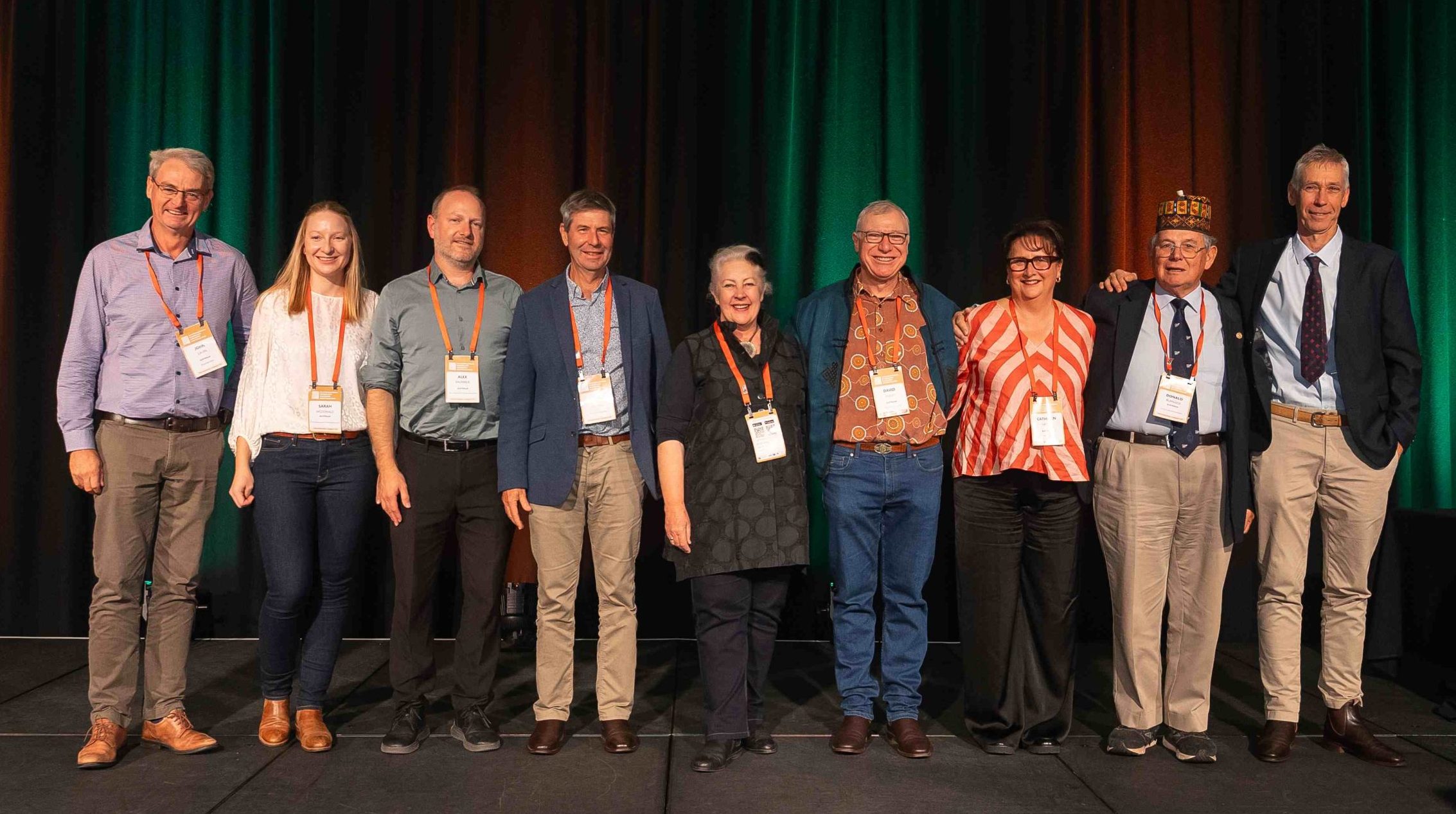
Photo 1: Members of the Organising Committee present at the Congress dinner. Left to right: John Gavin, Sarah Macdonald, Alex Baumber, Andrew Ash, Dana Kelly, David Phelps, Cath Waters, Don Burnside and Pieter Conradie. Absent: Nicole Spiegel, Saravan Peacock, Stephen van Leeuwen, Alison Nicolson and Cecile Godde.
Categories
- members area (11)
- News (35)
- Range Management Newsletter 15/2 (10)
- Range Management Newsletter 15/3 (12)
- Range Management Newsletter 16/1 (12)
- Range Management Newsletter 16/2 (9)
- Range Management Newsletter 16/3 (13)
- Range Management Newsletter 17/1 (15)
- Range Management Newsletter 17/2 (10)
- Range Management Newsletter 17/3 (12)
- Range Management Newsletter 18/1 (11)
- Range Management Newsletter 18/2 (13)
- Range Management Newsletter 18/3 (14)
- Range Management Newsletter 19/1 (15)
- Range Management Newsletter 19/2 (13)
- Range Management Newsletter 19/3 (11)
- Range Management Newsletter 20/1 (17)
- Range Management Newsletter 20/2 (20)
- Range Management Newsletter 20/3 (14)
- Range Management Newsletter 21/1 (17)
- Range Management Newsletter 21/2 (20)
- Range Management Newsletter 21/3 (21)
- Range Management Newsletter 22/1 (16)
- Range Management Newsletter 22/2 (17)
- Range Management Newsletter 22/3 (16)
- Range Management Newsletter 23/1 (16)
- Range Management Newsletter 23/2 (17)
- Range Management Newsletter 23/3 (14)
- Range Management Newsletter 24/1 (17)
- Range Management Newsletter 24/2 (14)
- Range Management Newsletter 24/3 (16)
- Range Management Newsletter 25/1 (12)
- Range Management Newsletter 25/2: Buffel grass Special Issue (11)
- Range Management Newsletter 25/3 (14)
- Range Management Newsletter 25/4 (12)